(written with inputs from my fellow biologist Kamal Azad)
 The Orang National Park in Assam is an important rhino habitats floodplain grassland habitat next to the famous Kaziranga National Park. The 78 sq km area is facing severe threats of poaching activities particularly for the rhino horn. Strong protection measures taken by the Forest Department, Assam is leading to conservation population of 60-70 rhinos in the park.
 The protection of habitat for rhino has added benefit to other animals in the park. Though small in size, a breeding population of tiger is thriving in the park. Aaranyak and Assam Forest Department is monitoring tigers and its prey animals regularly in the park since 2008.

As stripe of a tiger never lie, automatic cameras (trap camera) are used to photograph and monitor elusive mammals like tiger. The traps record almost everything happening on the trail or road it is placed. Though we target cameras for tigers all other animals are photographed using the trail that is certainly known to use by tigers. The camera traps help researchers and managers beyond their main objective understand individual identity and abundance of tigers. Information on other animals, activity pattern, health-injuries of animal, animal behaviours and so on can be simultaneously recorded in such camera traps.
 In the beginning of December 2010 we were ready for the fourth camera trapping operation in Orang National Park. Our target was is to capture all tigers in the park enriched with new digital PANTHERA[1] cameras and three years prior experiences about the tigers and terrain in the park. We were very excited to use these digital cameras for the first time. We had lots of bitter experiences using the film cameras and heavy gears during the last few years. All our cameras were installed by 29th December 2010. Then it is monitoring those regularly and knowing what is being captured, particularly our target, the tiger.
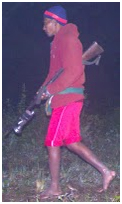
 On 9th January we learnt that one rhino was poached near Half Camp (N 26° 35’ 29.4”, E 92° 19’ 15.5”) and the horn was taken away. Next day we checked our camera nearest to that poaching location. Back in the field station we were going through the photographic events of that camera. The photographs of 5th January 2011 surprised us when we saw three persons armed with .303 rifles were walking on the road. We had little doubt that these guys were poachers; one of them was field guide.
We immediately informed Salim Ahmed, Range Officer and Sushil Daila, Divisional Forest Officer about the events recorded on camera. Poaching is not new in rhino bearing areas in Assam, but capturing poacher is new to us and we presumed that the culprits could be identified as the pictures were very clear, even though in side profile.
The park management acted swiftly and decided to hang poster with photo of the poachers in the fringe areas. A reward of Rs.25000/- to informer leading to identification and arrest of the gang was mentioned in the poster. In fact, the identity of the poachers was confirmed soon after the posters were hanged. Under pressure, the two armed poachers finally surrendered to police and then arrested and sent to jail.
It was indeed a satisfying moment to all of us, the Aaranyak team and the Park management as the poachers are now behind bar. We thank Panthera for developing this quality camera and giving us to use the same. The trap cameras also has proved in this case that they are not just for research and can be used for effective protection in the areas that are constantly under pressure from poachers.
[1] Panthera (www.panthera.org) is a global cat conservation organization and has developed a digital camera for cat monitoring.

